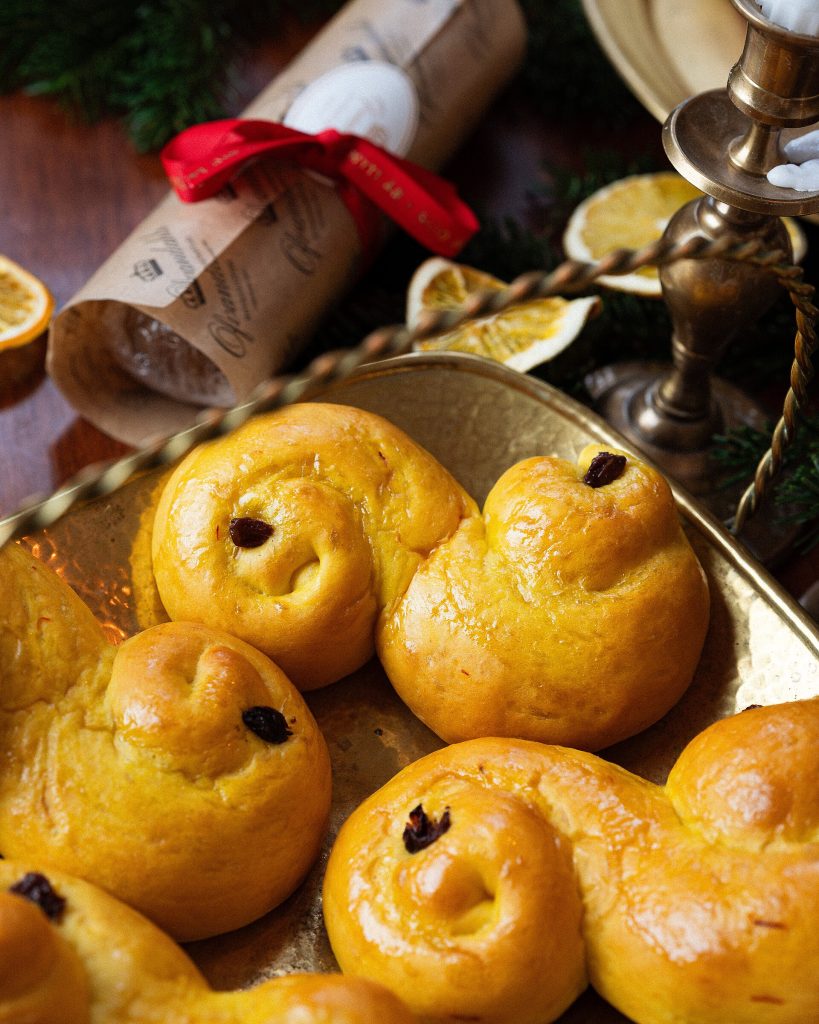
An ordinary lussekatt is not vegan. In a classic recipe such as Arla’s, the dough is made with butter, milk and quark, and the buns are brushed with beaten egg before they go into the oven. Swap the milk for oat or almond drink, the butter for dairy-free margarine and the egg glaze for melted margarine, and leave the quark out. The saffron, the S-shape and the raisins stay exactly as they are.
Four ingredients in a classic lussekatt come from animals
A typical Swedish recipe, such as the lussekatter recipe from the dairy company Arla, makes 35 buns from 100 g butter, 500 ml milk and 250 g quark, and finishes them with one beaten egg brushed over the top. The rest of the dough is fresh yeast, saffron, sugar, salt and wheat flour, which are vegan, and the buns are decorated with raisins.
Swedes bake lussekatter from the first Sunday of Advent until Christmas, and the buns belong above all to Lucia Day on 13 December.
What to use instead of milk, butter, quark and egg
- Milk: almond or oat drink (havredryck). ICA’s vegan saffron bun recipe uses 500 ml, the same volume as the milk in Arla’s dough.
- Butter: dairy-free margarine, labelled mjölkfritt margarin. ICA’s vegan recipe uses 175 g, which is more than the 100 g butter in the classic dough, so follow the vegan quantities rather than swapping gram for gram.
- Quark: leave it out. The vegan recipe has no quark or quark substitute, only the plant drink as liquid.
- Egg for brushing: melted dairy-free margarine, brushed on just before baking.
Margarine and plant drinks vary between brands, so check the ingredient list for mjölk (milk), smör (butter) and vassle (whey). Mjölk and smör are in our Swedish vegan glossary, and our guide to vegan groceries in Sweden explains how to read the labels.
How to bake 30 vegan lussekatter
This method follows ICA’s recipe for vegan lussebullar, another Swedish name for the same buns. It makes 30 buns and takes about one and a half hours, most of it rising time. You need fresh yeast and a mortar for the saffron, and no step calls for special skills or equipment beyond that.
Melt the margarine and grind the saffron
Put the raisins to soak in water for at least 30 minutes, then crumble 50 g fresh yeast into a large mixing bowl. Melt 175 g dairy-free margarine in a saucepan. Grind 1 g saffron, which is two 0.5 g sachets, in a mortar with a little of the 200 ml sugar. Stir it into the melted margarine. Add 500 ml almond or oat drink and warm the liquid to about 37°C.
Mix and knead the dough
Stir the yeast into a little of the warm liquid until it dissolves, then add the rest of the liquid, the remaining sugar and ½ teaspoon salt. Work in most of about 900 g plain wheat flour (vetemjöl). Knead the dough for about 5 minutes in a mixer or 10 minutes by hand. Cover the bowl with a tea towel and leave the dough to rise for 30 to 45 minutes.
Shape the buns into an S
Turn the dough out onto a floured worktop and knead in the rest of the flour if needed. Divide it into 30 pieces. Roll each piece into a long, thin rope, then curl the two ends in opposite directions towards the middle so that the rope forms an S. Place the buns on baking trays lined with baking paper.
Let the buns rise a second time
Cover the trays with a tea towel and leave the buns to rise for another 30 to 45 minutes. Heat the oven to 225°C, conventional heat, while you wait.
Brush with margarine and press in the raisins
Melt a little more dairy-free margarine and brush it over the buns. Drain the raisins and press them into the buns, as many as you like.
Bake and cool
Bake the buns in the middle of the oven for 8 to 10 minutes. Leave them to cool on a wire rack under a tea towel.
Four mistakes to avoid with vegan lussekatter
- Brushing with egg out of habit. The classic recipe from Arla ends with beaten egg. Use melted margarine for a vegan batch.
- The wrong margarine. The recipe calls for dairy-free margarine. Look for mjölkfritt or vegansk on the pack.
- Dry, burnt raisins. Skipping the soak leaves the raisins dry, and they can burn in the oven.
- Assuming bought buns are vegan. If you buy lussekatter instead of baking them, read the ingredient list on the bag, as explained in our vegan groceries guide.
Bake the day before and keep the buns airtight
Lussekatter made with Arla’s quark dough keep for up to two days in a plastic bag or an airtight tin at room temperature, and for up to three months in the freezer. Arla adds quark to make its buns keep better, so a vegan batch without quark may not keep as long. A batch baked on the evening of 12 December is ready for the office celebration the next morning. If colleagues ask, the Swedish for “these are vegan” is de här är veganska.
Where lussekatter probably come from, and when saffron was added
A sweet, yeasted wheat bread called duivekater is baked at Christmas in the Netherlands and northern Germany, and Dutch traders probably brought it to Gothenburg in the 1600s. To Swedish ears the name sounded like dyvelskatter or djävulskatter, devil’s cats, although the word probably has nothing to do with either cats or devils. When the buns became linked to 13 December, they were renamed lussekatter. Saffron did not come into use until the end of the 1800s. Today the S-shape is the most common form.
For other plant-based Swedish baking, our vegan fika guide covers kanelbulle, semla and princess cake. If the Lucia celebration leads on to a Christmas dinner, our guide to the vegan julbord explains which dishes on the Swedish Christmas table you can eat.
Last fact-checked: 11 November 2026